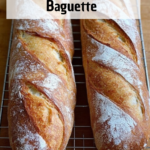
Crusty, Open-Crumb Baguettes Recipe

This recipe for Crusty, Open-Crumb Baguettes delivers beautifully light and airy bread with a golden, shatteringly crisp crust. Using a simple no-knead dough made from just four ingredients, the secret to success lies in allowing a long, slow fermentation and baking the bread in a steamy environment to enhance crust and crumb texture. Detailed step-by-step instructions guide you through mixing, stretching and folding, shaping, proofing, and baking using versatile tools such as a Challenger Bread Baker, Baking Steel, or Emile Henry Baguette Baker.
- Prep Time: 20 minutes
- Cook Time: 20 minutes
- Total Time: 48 hours 20 minutes (including slow fermentation and optional refrigeration)
- Yield: 4 baguettes
- Category: Bread
- Method: Baking
- Cuisine: French
- Diet: Vegan
Ingredients
Dough
- 550 grams (about 4¼ cups) bread flour or all-purpose flour, plus more for dusting
- 15 to 16 grams salt (see notes for salt type and measurement)
- 2 grams (about ½ teaspoon) instant yeast (SAF instant yeast recommended)
- 385 grams (about 1 2/3 cups) cold water (about 60°F)
Additional
- Extra-virgin olive oil (about 1 teaspoon for coating the dough)
- Flour for dusting work surfaces
Instructions
- Mix the dough: In a large bowl, whisk together the flour, salt, and instant yeast. Add the cold water and use a spatula to mix until a shaggy dough ball forms. If the dough seems dry, gently knead it by hand in the bowl until it comes together. Cover with a towel and rest for 15 to 30 minutes.
- Stretch and fold: Fill a small bowl with water. Dip one hand into the water, use the dry hand to stabilize the bowl, then grab an edge of the dough with the wet hand, pull it up and fold it toward the center. Repeat 8 to 10 times, turning the bowl 90 degrees between sets. This transforms the dough from shaggy to smooth and cohesive.
- Oil and rise: Pour about 1 teaspoon of extra-virgin olive oil over the dough and rub it evenly with your hands. Cover the bowl tightly and let the dough rise at room temperature until nearly doubled in size, approximately 6 to 10 hours depending on warmth.
- Portion the dough: Turn the dough out onto a lightly floured surface. Use a bench scraper to divide into four equal portions (~237 grams each). Form each into a tight ball by folding edges inward and dragging the dough to create surface tension.
- Store the dough: Place dough balls in individual airtight containers and refrigerate for 1 to 3 days for slow fermentation (optional but recommended for flavor and open crumb).
- Shape and proof: On baking day, remove dough from fridge. Lightly flour a surface as needed. Pat each dough ball into a 6×7 inch rectangle, then fold top down toward center and pinch gently, rotate 180º and repeat several folds creating an “envelope.” Roll the log tightly and pinch the seam closed. Place seam-side down in a floured DoughMate or baking pan inside a sealed bag. Let proof for 2.5 to 3 hours at room temperature until the dough passes the poke test (slowly springs back).
- Prepare baking vessel: Depending on equipment: preheat oven to 450ºF for 30 minutes with Challenger Bread Baker or Baking Steel inside. Butter the Emile Henry Baguette Baker but do not preheat it.
- Score the dough: Gently roll the dough log to release it. Transfer it to parchment paper if using Challenger or Baking Steel. Using a sharp blade, make three diagonal slashes evenly spaced along the top. If using Emile Henry baker, score dough inside the buttered vessel.
- Bake the baguette: For Challenger Bread Baker: Place dough on parchment in pan, cover, bake covered 10 minutes, uncover and bake 10 more minutes until golden brown. For Baking Steel: Slide dough on parchment onto steel, cover with aluminum pan weighted with a heavy skillet, bake 10 minutes covered, then 10 minutes uncovered. For Emile Henry Baker: Cover and bake 10 minutes, uncover and bake 10 minutes more to golden perfection.
- Cool: Remove baguettes from oven and cool for about 20 minutes before serving to allow crumb to set.
- Storage: Best eaten same day. To store, place in a ziplock bag at room temperature up to 3 days or freeze up to 3 months. Reheat at 350ºF for around 15 minutes for fresh crust.
Notes
- Use a scale for precise measurement of ingredients, especially flour and salt.
- Preferred flour: King Arthur Bread flour or Petra 0102 (partially sprouted wheat) for an even more open crumb.
- Salt: Diamond Crystal kosher salt preferred; if using fine sea salt or Morton kosher salt, adjust quantity accordingly to 2.5 teaspoons vs 5 teaspoons for Diamond Crystal.
- Yeast: SAF instant yeast recommended for best results.
- Long, slow fermentation (6-10 hours) improves flavor and texture and can be extended with refrigeration.
- Watch video tutorials (if available) before shaping to master technique.
- Baking tools options include Challenger Bread Baker, Baking Steel with improvised steaming setup, or Emile Henry Lidded Baguette Baker.
- Use water to wet one hand during stretch and fold to handle dough more easily without sticking.
- Scoring is critical for oven spring and creating the classic baguette look.
Find it online: https://recipeplenty.com/crusty-open-crumb-baguettes-recipe/